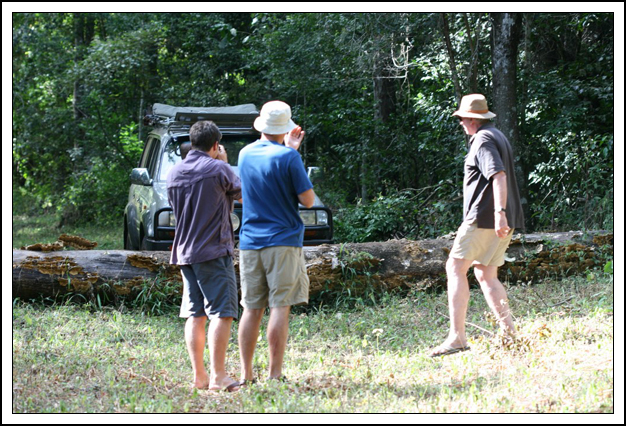
This is what happens when you look for a shortcut through the woods at Lake Paradise. Photo by Chris Fletcher.
The plan was to drive down off the mountain and into one of the villages around Marsabit to check out the local culture. When we’d met the head warden of Marsabit, Robert Obrien, he’d told us that the tribes in this area—Rendille, Borana, Gabbra, Turkana—are fascinating and worth a visit.
“When the road comes (the one the Chinese are building) it will bring tourism to this area for the first time,” he told us. “I don’t want tourists to come for the animals. I want them to come for the culture. The culture is unique. The thing is the cultures of the people.”
And then he told us of a couple of villages that we might go to. So that was the plan. But in Kenya plans are meaningless. We planned for the KW (Kenya Wildlife) to bring us water because we were running low and they did; but they brought the water in used petrol barrels and we couldn’t use it. We planned to restock on Tusker in Marsabit but there was none to be had. That’s the way it is in Africa.
Rather than take the same road down the mountain that we’d taken to get here, Calvin decided that it would be quicker to try the trail to the north. You would think by now that we would know better than to look for shortcuts (particularly considering that it was Martin Johnson looking for a shortcut to Lake Paradise that started all the problems with Calvin’s great-uncle Bud), but we have not learned that lesson.
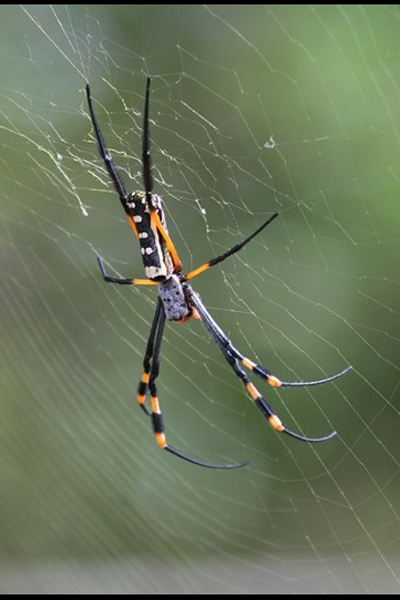 The track was narrow and overgrown. Hardy and Fletch and Pedro sat on the roof of the Land Cruiser, giving Calvin instructions on how to avoid a fallen log or a large bush that seemed to block the trail. Sometimes we’d stop the car and all get out and evaluate the situation and Pedro would take his Swiss Army knife which had a 3-inch serrated blade on it and hack away at some sapling or a branch. Then Calvin would push into the growth like a rhino charging through the bundu and miraculously make it through. It was cool and moist in the forest and smelled of decay and greenery and, once in awhile, of fresh dung. The webs of golden orb spiders were everywhere and every few minutes one of the boys sitting on the roof of the vehicle would shout and Calvin would stop the car and we’d all watch Fletcher or Hardy try to brush away the long-legged creepy crawly that had fallen on their hat or their shirt.
It wasn’t long before we came to a spot in the forest where a good-sized tree had fallen across the road, probably pushed over by an elephant, and it was impossible to go on. The log was fresh and wet and too heavy to move. After surveying the situation, we determined that by moving a few fallen branches to the side of the road and knocking over some of the smaller inch-thick saplings it might be possible to go around the fallen tree through the forest. We did this once and then we did it again, taking a good half-hour every time, and then we came to another tree across the road, this one several feet in diameter, and it looked like it would be impossible to go any further.
We all got out and walked through the forest, looking for some possible access, following the line of least resistance, going deeper and deeper into the woods, which is when we stumbled across a small herd of elephants making their way down the forest path to the meadow. There are three situations in which animals like the elephant are dangerous: when they are with their young, when you surprise them, and when you are between where they are coming from and where they are going.
We’d hit the jackpot.
Tags: Lake Paradise
 Loading ...
 Jamaica
 Vanuatu
 Scotland
Recent Comments