Ile de Re

You are currently browsing the archive for the Ile de Re category.

Soaking up the sea

This morning I was enveloped in a womb of seaweed paste, covered head to foot in a green gorp, then wrapped in plastic like a log of fresh cheese. For an hour, I incubated in the basic elements of the sea, again going off into that strange half-conscious dream state, a slightly hallucinatory soup of sounds and thoughts of my childhood, people I’ve loved, dead relatives, fears, joys, regrets. Many regrets.

And then Claire came back into the room, gently waking me, telling me to take a shower, wash off the elements of the ocean.

Vous êtes complet,” she said. “Vous pouvez rentrer.”

I am complete. I can go home.
 

photo by David Lansing

photo by David Lansing

I spent a very long time under the hot shower, thinking about all this, and then I dressed and went back to the reception room where Claire was waiting for me. I gave her my red robe and towel as well as the red slippers, which, she says, I can keep. For a souvenir. Perfect.

“How do you feel?” she asked.

“Like a man who has been reborn,” I told her.

She nodded. “This is something we often hear. It is a good feeling, yes? It makes your heart happy? Now you are balanced from the sea.”

Tomorrow morning I will drive over the arching bridge that connects the island to the mainland and back to Bordeaux where I will catch a flight to Nice. I will miss Île de Ré. But I will take some of it back with me. From the salt, the oysters, and the wine, but mostly from the sea.  

Tags: , ,

The ménage à trois massage

An intensive day at the thalasso. First I go down a long white corridor where people shuffle by in robes and slippers (talk about god’s waiting room) to a room marked douche a jet. Claire using hand motions, instructs me to stand at the far end of a tiled room, my naked backside to her. She turns on a thick hose and methodically sprays my naked body with warm seawater. First my legs, than my ass, back, shoulders. Turn to the left and repeat. To the right, repeat. Face her, eyes closed, and she flushes my front with the hard spray of seawater. The whole affair leaves me trembling and feeling slightly humiliated. I like it.

The next treatment is called modelage sons affusion. With me lying naked on a plastic table and seawater spraying in from multiple jets above my body, Claire and an assistant massage and coat me in a thick, waxy white layer of goo. Their arms move over me like those of an octopus. Each muscle on the left side of my body is massaged and matched by the other masseuse massaging the same muscles on my right side. The only sound in the room comes from the soft spray of sea water (no Enya in this spa) and the involuntary sighs I emit.


photo by David Lansing

photo by David Lansing

I’m not sure what to make of all this. It’s very unlike the traditional American spa treatments which tend to make you feel good about yourself. Here, everything seems designed to slightly humiliate you. It makes you feel like an unclean baby coming out of the womb. Also, there’s something oddly religious about the whole thing. I mean, today I kept feeling like I was little more than a corpse being prepared for my first head-to-head with The Big Man. And Claire and her assistants were really just angels.

Tomorrow I have my final treatment: a seaweed wrap. To get the elements of the ocean into my skin. I don’t know about dust to dust. Perhaps it should be ocean to ocean. 

Tags: , ,

Dull soup

The restaurant at the Atlante Hotel is a rather forlorn place. Or perhaps it just feels that way because of the weather: gray, flat, still. I sit at a table looking out at a lighthouse, blinking forlornly, offshore. Two old men in a dinghy slowly row ashore from a fishing boat moored off the banks. A path paved in crushed limestone parallels the shore and I can see a few couples catching the sea air before dinner. But their arms are crossed, their hands buried in their trouser pockets. They look down at their feet, bored. With each other, with the day, with their lives? Who knows.


photo by David Lansing

photo by David Lansing

My waiter looks like Joel Gray in “Cabaret,” right down to the mascara, and speaks better English than I do. I order a glass of the Île de Ré cognac as an aperitif. It’s served in a special inverted bell-shaped glass which sits in a cocktail glass of crushed ice—like a bowl of pale honey surrounded by thick granules of salt.

I sip the cognac, glance at the other bored or tired diners around me, all of us silently sitting here as the sun sets. Terroir is an interesting word. It generally means that something—oysters, wine, cheese—derives its special character partially as a result of the land, the nutrients, and the weather from which it comes. But there is a terroir to dining as well. A most excellent fish soup may taste quite ordinary in a setting that fails to inspire. Conversely, some pretty simple fare has tasted extraordinary to me because of the glow of a candle, the scent of seaweed in the air, the clarion of a flock of seagulls.

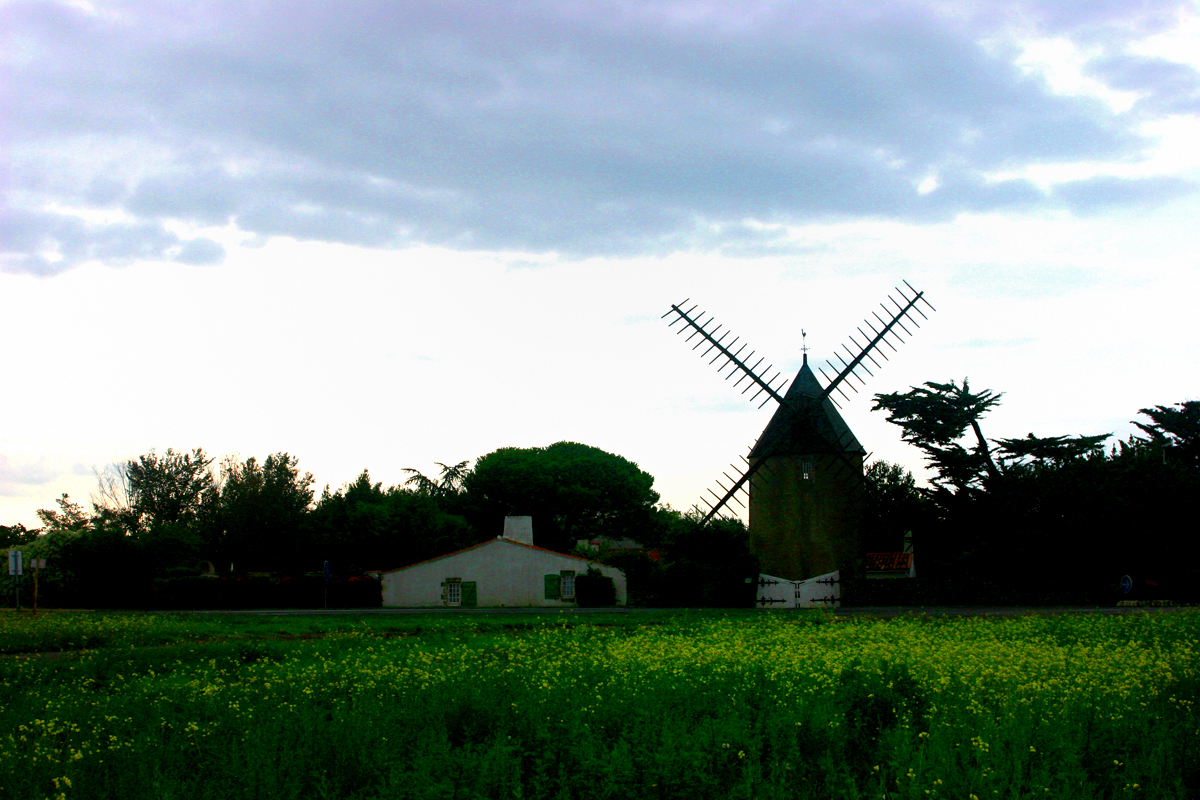
But tonight the dinner is as dull as the weather. I skip the cheese plate, pay my bill, and walk back to my room, passing a solitary windmill, silhouetted against the sky, in a field of yellow flowers. It looks like rain is approaching. Summer is over. It is time to leave the island. 

Tags: ,

The purge

There is one other thing for which Île de Ré is well known: their thalassos. If you don’t know, a thalasso is a spa that is near the sea and uses the benefits of sea water in their treatments. In fact, the root word (thalassa) is Greek for “sea.” They say the composition of ocean water is very close to the composition of plasma in our body. We are, in other words, made mostly of sea water. How perfect is that?


photo by David Lansing

photo by David Lansing

So I have arranged to spend my last few days on the island at a thalasso in Sainte-Marie-de-Ré. My therapist, Claire, issues me a red robe, a red towel, and—yes—red slippers. She instructs me to prepare myself for my first treatment, a hydrotherapy soak in warm saltwater. After I’ve changed, she leads me into a small room with a large tub facing a window looking out on the Atlantic. She checks the temperature of the water and says, “You should soak for at least an hour. To enrich yourself. We are sea animals—we need the minerals and elements that the sea provides.” Then she closes the door and leaves me to myself.

I feel as vulnerable as an exposed oyster, enveloped up to my chin in warm, green sea water. Outside, the ocean shimmers like shards of broken glass. Seabirds fly low over the waves. I close my eyes as hydrojets—like gentle hands—push and pull my limbs.

I can’t possibly be sleeping, yet I am in some sort of strange dream-like state. Like when you’re on a plane and you’re both dreaming and aware of sound and movement around you. The images in my head swirl and blend—the ocean, fish, swimming, children laughing, the voices of old lovers. It is like I’m being purged of something. Or reborn.

Tags: , ,

Bernard Adam wants to know if I’m going to be on Île de Ré on the 27th of this month and I tell him, No, I’m leaving at the end of the week.

Ah, too bad, too bad, he says, pouring me a glass of the local white wine, called Le Royal. He says that on the 27th, the islanders celebrate the Fête des Vendanges which begins with a procession carrying a statue of St. Vincent from the church in Le Bois Plage and ends with lots of eating and drinking of the new wine.

“On this island, we love St. Vincent,” he says. “He saved us.” Bernard explains how, for hundreds of years, they have been making wine on the island. And then the phylloxera came and just about wiped out the vino business.

“So we prayed to St. Vincent, the patron saint of vintners and wine growers, and the phyloxera was gone the next year. Now we thank him with a fête on his feast day.”


photo by David Lansing

photo by David Lansing

  I think this is a wonderful story. But it’s also a crock. First of all, the phylloxera did indeed wipe out the vines on Île de Ré  as well as most of France between 1860 and 1900, but St. Vincent wasn’t the savior of island wine growers. That would be J.E. Planchon who figured out that if you grafted French vines onto disease-resistant U.S. root stock, you could control the problem. Unfortunately, they didn’t make Professor Planchon a saint (though he did get a statue which stands just outside the Montpellier train station).

But here’s the really interesting thing: There are two (at least) St. Vincents. One was born in Huesca, Sapin in the third century and he is, indeed, the patron saint of vintners and wine growers. However, his feast day is Jan. 22. The more familiar saint is St. Vincent de Paul, who was born in France, died in Paris and whose feast day is, indeed, Sept. 27. Except he has nothing to do with grapes or wine (though he is the patron saint of charitable societies). So somewhere along the line, the wine growers of Île de Ré blended a 3rd century Spanish saint with a 17th century French one and came up with the Fête des Vendanges—sort of a Catholic meritage. Which makes perfect sense when you realize that Le Royal, after all, is a blend of sauvignon blanc, chardonnay, and colombard. It seems that everything on this islands, including saints, is a blend of things. 

Tags: , , ,

« Older entries